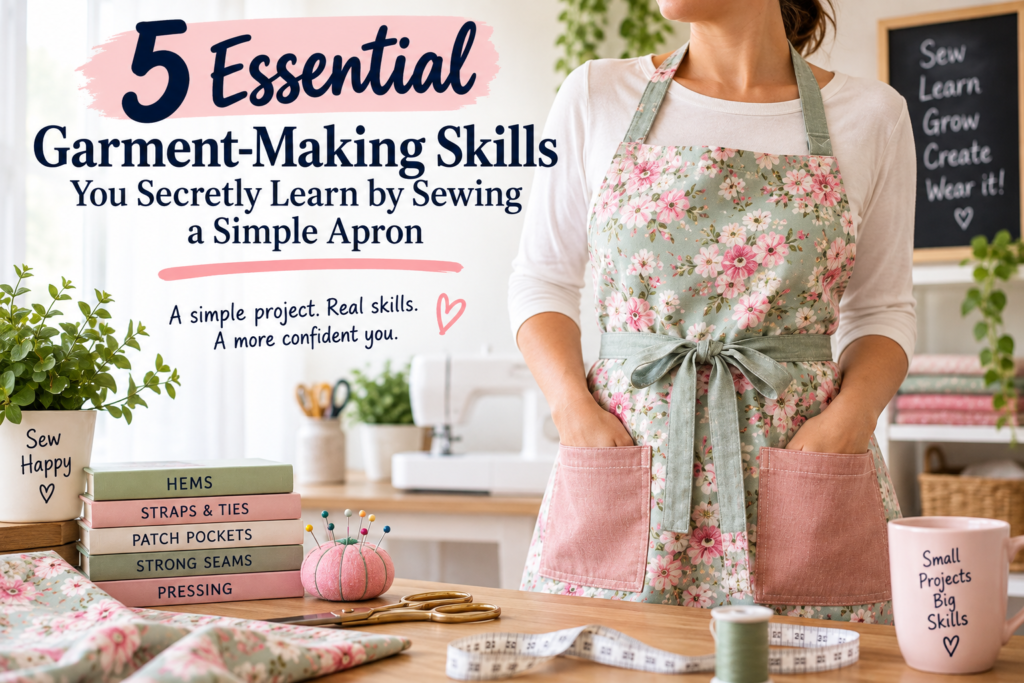

If you’ve ever mentally filed the apron under “beginner busywork” — a project you have to get through before you’re allowed to touch real clothes — it’s worth a second look. An apron isn’t a consolation prize while you work up the nerve to sew clothing. It’s a disguised clothing-construction lesson, and it’s one of the best beginner apron sewing tutorials you can run yourself through before ever picking up a garment pattern.
The Apron as a Stepping Stone to Clothing
The reason so many new sewists gravitate toward aprons isn’t just that they’re quick. It’s that an apron removes the one variable that trips up almost every beginner: fit. There’s no bust dart to fuss over, no waistband that has to sit exactly right on a body, no grading between sizes. You get to practice on flat, forgiving fabric with ties that adjust to fit anybody.
Strip fit out of the equation, and what’s left is pure technique — the exact techniques that show up over and over in real garments. That’s the throughline behind all the sewing skills learned from an apron: it’s not that the apron teaches you “apron things.” It’s that it teaches you clothing things, minus the pressure of a body underneath them.
Skill #1: Double-Fold Hems & Edge Pressing
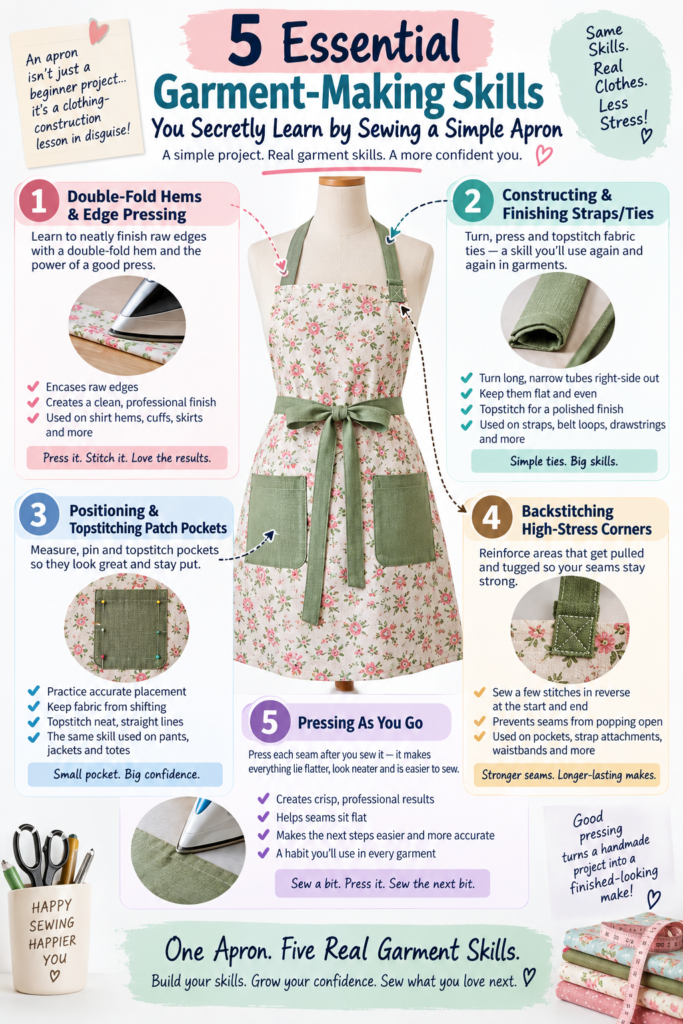
Every apron has raw edges that need to disappear, and the way you make them disappear is the double-fold hem — fold the fabric edge over once, fold it again to fully enclose the raw edge, then press it flat before you stitch. It sounds small. It isn’t. This is the exact same technique that finishes shirt hems, sleeve cuffs, and the bottom edge of a skirt.
What an apron teaches you that a rushed tutorial won’t is the pressing part. A crisp, ironed fold is what makes a hem look intentional instead of homemade-in-the-bad-way. Sewists who skip the iron on their apron tend to skip it on their first garment too, and it shows immediately — wavy edges, uneven stitching lines, a hem that puckers instead of lying flat.
Skill #2: Constructing & Finishing Straps/Ties
Apron ties look simple: a long strip of fabric, folded and stitched into a narrow tube, then turned right-side out. Turning a long, skinny tube of fabric right-side out without twisting it, losing the seam allowance, or fraying the corner is a genuinely fiddly skill — and it’s one you’ll lean on constantly once you move into garments. Spaghetti straps, belt loops, fabric ties on a wrap dress, drawstrings on pajama pants — they’re all this same construction, just at different lengths.
Once the tie is turned and pressed flat, topstitching it closed adds the second half of the lesson: sewing a straight, even line close to a folded edge. That’s a skill you’ll use on plackets, collars, and waistbands for as long as you sew.
Skill #3: Positioning & Topstitching Patch Pockets
A patch pocket seems like decoration, but positioning one correctly — measuring, pinning it so it doesn’t pull off-grain, and topstitching it down without the fabric shifting under your presser foot — is a core garment skill in miniature. This is precisely what you’re doing when you attach a pocket to a pair of pants, a jacket front, or a tote bag lining later on.
The apron is a forgiving place to make your positioning mistakes. If a pocket ends up a half-inch off-center on an apron, nobody notices and nothing is ruined. Make that same mistake on the front of jeans, and you’re unpicking stitches from actual denim. Practice the alignment here first.
Skill #4: Backstitching High-Stress Corners
Every place your apron gets grabbed, tugged, or tied — the corners where a strap meets the bib, the top corners of a pocket — is a stress point. Backstitching those spots (sewing a few stitches in reverse at the start and end of a seam to lock it) keeps the seam from popping open the first time it’s put through actual use.
This is exactly the reinforcement you need at the corners of pockets, the base of a fly zipper, or anywhere a seam will face repeated pulling on a real garment. An apron gets pulled on, tied, and untied constantly, which makes it a surprisingly good stress-test for a technique you’ll rely on for the rest of your sewing life.
Skill #5: Pressing As You Go
If there’s one habit that separates finished-looking makes from lumpy ones, it’s pressing as you go — running the iron over each seam right after you sew it, before moving to the next step, rather than saving all the ironing for the end. Pressed-open or pressed-to-one-side seams sit flatter, are easier to sew over accurately, and make the whole piece behave better as you keep building on it.
An apron has just enough seams to make this habit stick without it feeling tedious. By the time you finish, “sew a bit, press it, sew the next bit” starts to feel automatic — which is exactly the rhythm that makes garment sewing manageable instead of overwhelming.
Why This Matters More Than It Looks Like It Does
None of these five skills are apron-specific. They’re the actual mechanics of garment construction, taught through a project with zero fitting stress and low-stakes fabric. Treat your apron like a real sewing lesson instead of a warm-up, and you’ll walk into your first real garment already knowing how to hem, how to finish a strap, how to place a pocket, how to reinforce a seam, and how to press like it matters — because it does.
So — of these five, which one sounds the most intimidating to you right now? Drop it in the comments. And if you know someone who’s just getting started and thinks aprons are “too basic” to bother with, send them this post.