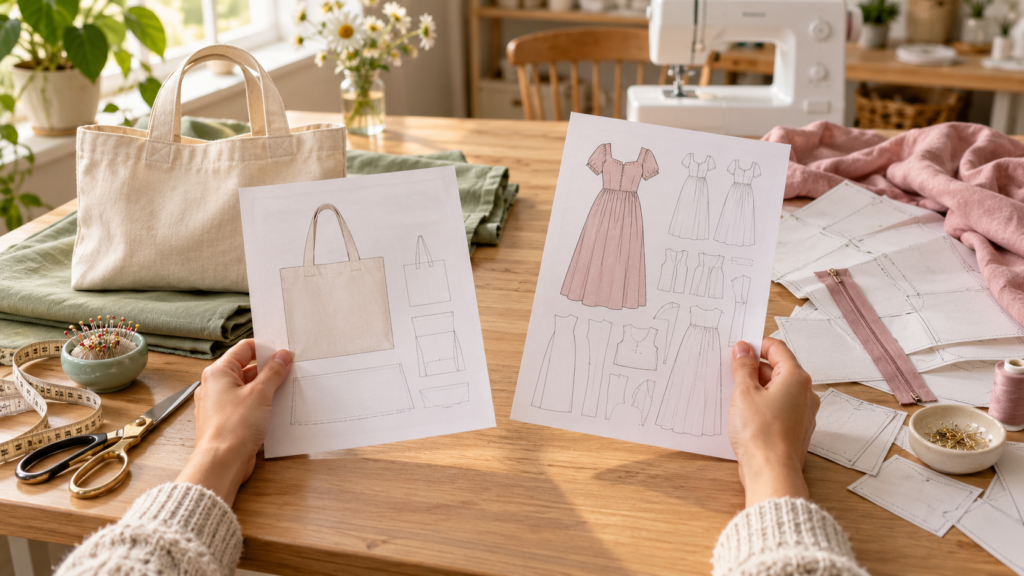

You find a pattern with a big, friendly “Easy” on the front. You love the finished dress in the photo. You buy the fabric, bring it home, and open the instructions.
Then the surprises start. There are eleven pattern pieces. There’s an invisible zipper. The fabric recommendation turns out to be a slippery rayon. And step 4 tells you to “understitch the facing” as if you already know what that means.
If that sounds familiar, you didn’t fail. You were given one clue and asked to make a decision that needs six.
The word “easy” on a pattern envelope is only one piece of information. A genuinely beginner-friendly sewing pattern is the result of several things working together:
- the type of project
- the skill level it’s written for
- how many pattern pieces it has
- the fabric it calls for
- the techniques it requires
- how good the instructions are
When all six line up, you have a project you can realistically finish. When even two or three work against you, an “easy” pattern can feel anything but.
This guide walks you through each of those six checks so you can judge a pattern before you buy it, download it, or cut into your fabric. Here’s the quick visual version — keep reading for the details behind each point.
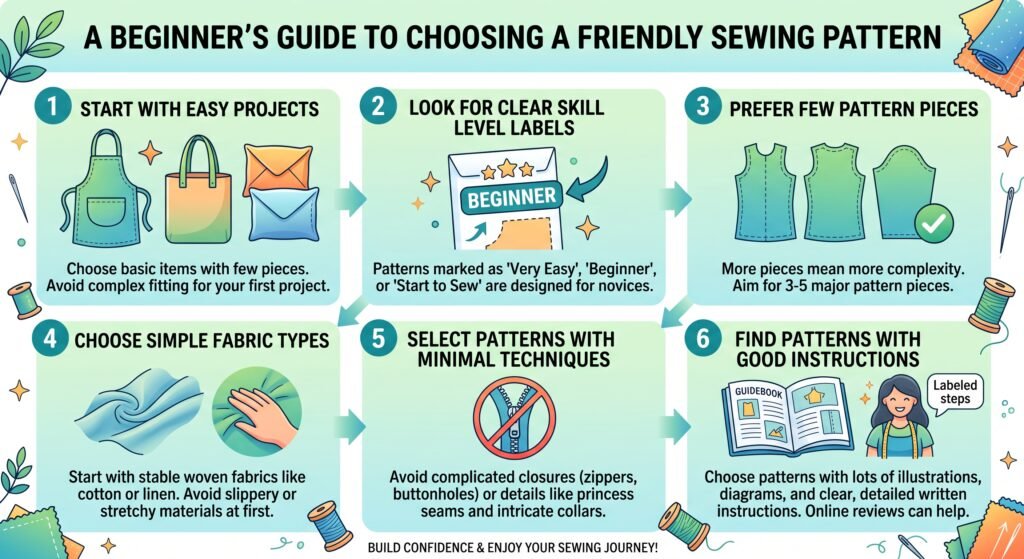
1. Start With an Easy Project
Before you look at the pattern itself, look at what it makes. The project type sets the baseline difficulty — everything else adds to it.
Why the project matters
Some projects are mostly straight lines, flat shapes, and simple seams. Others need to curve around a human body, fit correctly, and open and close. Those are very different challenges.
Good easy sewing projects for beginners include:
- Tote bags — rectangles, straight seams, and simple straps
- Pillow or cushion covers — especially envelope-style covers, which need no zipper or buttons
- Simple aprons — flat pieces, hems, and ties
- Basic zipperless pouches or drawstring bags — small, quick, and forgiving
These projects let you practice the core skills — cutting accurately, sewing a straight seam, pressing, and hemming — without worrying about whether the result fits.
What about clothes?
Garments aren’t off-limits for beginners. Plenty of people make an elastic-waist skirt or simple pajama pants as their first project and do just fine.
The difference is that fitted garments bring extra challenges along with them:
- choosing the right size and possibly adjusting it
- sewing curves, like necklines and armholes
- closures, such as zippers or buttons
- sleeves that have to be eased into place
- darts (small folded, stitched wedges that shape fabric around the body)
Each of these is learnable. The point is to avoid learning all of them at once.
Warning signs
- The photo shows a close-fitting garment with a defined waist or shaped bodice
- The description mentions “fitted,” “tailored,” or “structured”
- You’d need to take several body measurements and compare them to a size chart before you start
What to do
Ask yourself: Does this project need to fit a body? If yes, look for a looser or elastic-waist version, or save it for your second or third project. If you want to sew clothing right away, choose the simplest silhouette you like.
2. Look for Clear Skill-Level Labels
Most pattern companies rate their patterns. You’ll see labels like:
- Beginner
- Very Easy
- Easy
- Learn to Sew
- Start to Sew
These are useful starting points. A pattern marked “Learn to Sew” or “Start to Sew” is usually written with first-timers in mind, and often includes extra explanation.
Why a label isn’t a guarantee
Difficulty labels can vary from one pattern company or designer to another. One company’s “Easy” might assume you’ve already sewn a few garments. Another’s might truly mean your first time at a machine. Independent designers each set their own scale, too.
So treat the label as a first filter, not a final answer.
“Beginner” is a label. The construction requirements tell you what you’ll actually have to do.
What to check next
Once a pattern passes the label test, look past it:
- The technical drawing — the flat line drawing of the finished item. It shows seams, darts, closures, and details that a styled photo can hide.
- The notions list — the extra supplies you’ll need, such as zippers, buttons, elastic, or interfacing (a stiffening layer fused or sewn to fabric). A notions list containing closures, interfacing, specialty hardware, or other extras can be a clue that additional techniques are involved.
- The fabric suggestions — do they recommend stable cotton, or drapey rayon and silk?
- The pattern description — words like “lined,” “fitted,” or “invisible zipper” are clues.
Warning signs
- “Easy” on the front, but the notions list includes a zipper, buttons, and interfacing
- The technical drawing shows many seam lines or small details
- The label is only “Easy” with no explanation of what that means for this designer
What to do
Use the label to narrow your options, then spend two minutes with the technical drawing and notions list before deciding.
3. Prefer Fewer Pattern Pieces
Pattern pieces are the paper (or printed PDF) shapes you trace or cut, then use to cut your fabric. Every piece is something you have to cut accurately, mark, keep track of, and eventually sew to another piece.
Why fewer pieces helps
More pieces usually mean:
- more cutting and marking
- more seams to line up
- more steps in the instructions
- more chances to mix up which piece goes where
For a first project, around 3–5 major pattern pieces is a helpful guideline. “Major” means the main shapes — a front, a back, a sleeve — not small extras like a pocket or a strap.
This is a rule of thumb, not a sewing law. A pattern with seven pieces isn’t automatically too hard.
Why the count alone doesn’t tell the whole story
Piece count and difficulty don’t always move together:
- A pattern with four pieces could still include a fitted bodice, an invisible zipper, and a lining. That’s a lot of new skills.
- A pattern with eight pieces could be a simple tote with a separate bottom panel, straps, and pockets — all straight seams, with excellent step-by-step photos.
So look at two things together: how many pieces there are, and what you’re asked to do with them.
Warning signs
- Many small pieces, such as collar stands, cuffs, plackets, or facings
- Pieces with lots of notches, dots, and markings to match up
- Several pieces that look almost identical and are easy to confuse
What to do
Find the pattern piece list — it’s often on the back of the envelope or in the first pages of a PDF. Count the major pieces, then skim what each one becomes. If most of them join with simple straight seams, you’re in good shape.
4. Choose Simple Fabric Types
The same pattern can feel easy in one fabric and frustrating in another. Fabric is one of the most overlooked sources of difficulty for a first sewing pattern.
Why stable fabric makes life easier
A woven fabric is made by interlacing threads at right angles, like a tiny basket weave. A stable woven holds its shape: it doesn’t stretch much, slide around, or fray wildly.
Stable fabrics are easier to:
- cut — they lie flat and stay put under your scissors or rotary cutter
- pin or clip — the layers don’t slip apart
- align — edges match up and stay matched
- press — they take a crisp crease from the iron, which helps with hems and seams
- feed through the machine — they move evenly without puckering or stretching
Good beginner-friendly choices include:
- Quilting cotton — crisp, affordable, and available in endless prints
- Cotton poplin — smooth and stable, a little lighter and softer than quilting cotton
- Linen or linen blends — lovely to press, as long as you choose one that isn’t very loose-woven or slippery
Fabrics that add another skill
Some fabrics bring their own learning curve:
- Slippery fabrics like satin, charmeuse, or some rayons slide while you cut and sew
- Very stretchy knits can stretch out of shape and often need special stitches or needles
- Delicate fabrics like chiffon or fine silk snag, shift, and show every mistake
- Loosely woven fabrics can fray and distort as you handle them
You can absolutely learn to sew these. They just add one more thing to manage while you’re still getting comfortable with the basics.
Warning signs
- The pattern only suggests drapey, slippery, or stretchy fabrics
- The fabric list includes words like “chiffon,” “satin,” “jersey,” or “crepe”
- The sample photo shows a fabric with lots of flow and drape
What to do
Check the suggested fabrics before you buy. If a stable cotton or linen is on the list, start there. If none are, that pattern may be better as a later project.
5. Select Patterns With Minimal Techniques
If you’re trying to look beyond the skill-level label, the techniques list is one of the most useful places to check. The number of unfamiliar techniques is often a better clue to difficulty than the word “Easy.”
Techniques that can raise the difficulty
These features commonly add complexity:
- Zippers — especially invisible zippers, which need precise stitching
- Buttonholes — sewn openings for buttons, made with a special machine setting or foot
- Buttons and plackets — a placket is the finished opening strip where buttons sit, like on a shirt front
- Set-in sleeves — sleeves sewn into a closed armhole, which need easing to fit smoothly
- Complicated collars — such as shirt collars with separate stands
- Intricate seams — like princess seams, long curved seams that shape a garment
- Tricky pockets — welt or inseam pockets with several steps
- Facings — pieces that finish a neckline or armhole from the inside
- Gathering — drawing up fabric into even ruffles or fullness
- Darts — stitched folds that add shape
- Slippery fabric handling — see section 4
None of these is automatically too hard for a beginner. Many beginners sew a simple zipper pouch early on and do well.
The real issue: skill stacking
The problem is what happens when techniques pile up. Call it skill stacking:
- One unfamiliar technique is usually manageable. You can slow down, watch a tutorial, and practice on scraps.
- Five unfamiliar techniques in the same project is a different story. Every step becomes new, and one mistake can affect everything that comes after.
A pattern with darts, a facing, a zipper, set-in sleeves, and a slippery fabric may still be labeled “Easy.” But for a first project, that’s five new skills to learn at the same time.
What to do
List the techniques the pattern needs, then mark which ones you’ve never done. Aim for a project where most of the construction is straightforward and only one or two things are new. That way you can focus on learning them well.
6. Find Patterns With Good Instructions
A technically simple pattern can still be frustrating if the instructions assume knowledge you don’t have yet. Good instructions are like having a patient teacher beside you. Poor ones leave you guessing.
What good beginner instructions include
- Clear written steps in a logical order, one action at a time
- Illustrations or diagrams for each step, showing the right side and wrong side of the fabric
- Clearly labeled pattern pieces with names and numbers that match the instructions
- Explanations of unfamiliar terms — a glossary, or a short note the first time a term appears
- Seam allowance information — the distance between the fabric edge and your stitching line, stated clearly (for example, 5/8″ or 1 cm)
- Fabric recommendations and yardage for each size
- Cutting layouts — diagrams showing how to place pieces on your fabric
- Pressing instructions — when to iron and how, which makes a big difference to the finished look
- Explained markings — what the notches, dots, and grainline arrows mean and how to use them
- Photos or video tutorials for trickier steps, where available
Warning signs
- Instructions are mostly text, with few or no pictures
- Steps combine several actions, like “Attach collar, finish seams, and topstitch”
- Terms are used without explanation
- Seam allowance isn’t stated, or is hard to find
- Reviews mention confusing steps or errors
How to check before you buy
You often don’t have to guess:
- Read the pattern description for mentions of illustrated or photo instructions
- Look for preview pages — many PDF pattern designers share sample instruction pages
- Check reviews and blog posts from people who’ve made it, especially other beginners
- Search for sew-alongs or tutorials — a video walkthrough can carry you through any confusing step
What to do
Before committing, try to see at least one page of the actual instructions. If you can follow what it’s asking, that’s a very good sign.
The 60-Second Beginner Pattern Test
Here’s how to put all six checks together before you buy. Ask yourself:
- Is the finished project itself simple?
- Is the pattern clearly intended for beginners?
- Does it have a manageable number of major pattern pieces?
- Can I make it in a stable, easy-to-handle fabric?
- Does it introduce only one or two unfamiliar techniques?
- Are the instructions detailed enough for my current skill level?
You don’t need six perfect “yes” answers. A “no” on one question can be fine — especially if it’s the one new skill you want to learn. The goal is to spot where the difficulty is hiding before you commit your time and fabric.
Example: two “beginner” patterns side by side
| Pattern A | Pattern B | |
|---|---|---|
| Label | Beginner | Easy |
| Major pieces | 4 | 4 |
| Fabric | Stable cotton | Slippery rayon recommended |
| Closure | None | Invisible zipper |
| Fit | Loose, no fitting needed | Fitted bodice |
| Techniques | Straightforward seams and hems | Several unfamiliar techniques |
| Instructions | Illustrated, step by step | Sparse, mostly text |
Both patterns look beginner-friendly on the front. Both have just four pieces.
But Pattern B asks you to handle a slippery fabric, sew an invisible zipper, fit a bodice, and learn several other new techniques — with thin instructions to guide you. That’s a stack of new skills, and any one of them could stall the project.
Pattern A asks you to cut stable fabric, sew straight seams, and follow clear pictures. That’s a much more manageable combination for a first project.
The One Question to Ask About Any Pattern
If you remember nothing else, remember this:
How many new things is this pattern asking me to learn at the same time?
A beginner-friendly sewing pattern isn’t defined by one word on the envelope. Difficulty comes from the combination of the project, the pattern pieces, the fabric, the techniques, the fit, and the quality of the instructions.
Your first pattern doesn’t need to be the most impressive thing you could make. It needs to give you a real chance to finish, learn something, and feel confident enough to start the next one. A finished tote bag teaches you more than a half-finished dress sitting in a drawer.
Once you’ve chosen a pattern that looks manageable, the next step is checking it before you cut into your fabric. Use this sewing pattern checklist before cutting fabric to catch potential problems early.
Frequently Asked Questions
What makes a sewing pattern beginner-friendly?
A simple project, a manageable number of pieces, a stable fabric, only one or two new techniques, and clear illustrated instructions. The skill-level label helps, but it’s the combination of these factors that makes a pattern truly easy.
How many pattern pieces should a beginner start with?
Around 3–5 major pieces is a helpful guideline for a first project. It’s not a strict rule — a pattern with more pieces can still be easy if the construction is simple and the instructions are clear.
What fabric is easiest for a beginner to sew?
Stable woven fabrics like quilting cotton, cotton poplin, or a medium-weight linen blend. They stay put while you cut, press crisply, and feed evenly through the machine.
Should a beginner avoid zippers?
Not necessarily. A zipper can be a great single new skill to learn — a simple zipper pouch is a classic early project. Just avoid pairing your first zipper with several other new techniques in the same project.
Can a beginner start by sewing clothes?
Yes. Choose a loose-fitting garment with an elastic waist or simple shape, in a stable woven fabric, with clear instructions. Save fitted styles with zippers, darts, and set-in sleeves for once you’ve built a few basics.
Can I trust a pattern labeled “Easy”?
Use it as a starting point, not a promise. There’s no universal standard, so check the technical drawing, notions list, fabric suggestions, and a sample of the instructions to see what the pattern actually asks you to do.