
You bought the machine. You watched a few tutorials. You’re ready to sew.
And in your head, the finish line already looks like something specific: a flowy summer dress, a tailored button-down, maybe that wrap top you keep saving to Pinterest. It makes sense — clothes are why most people learn to sew in the first place.
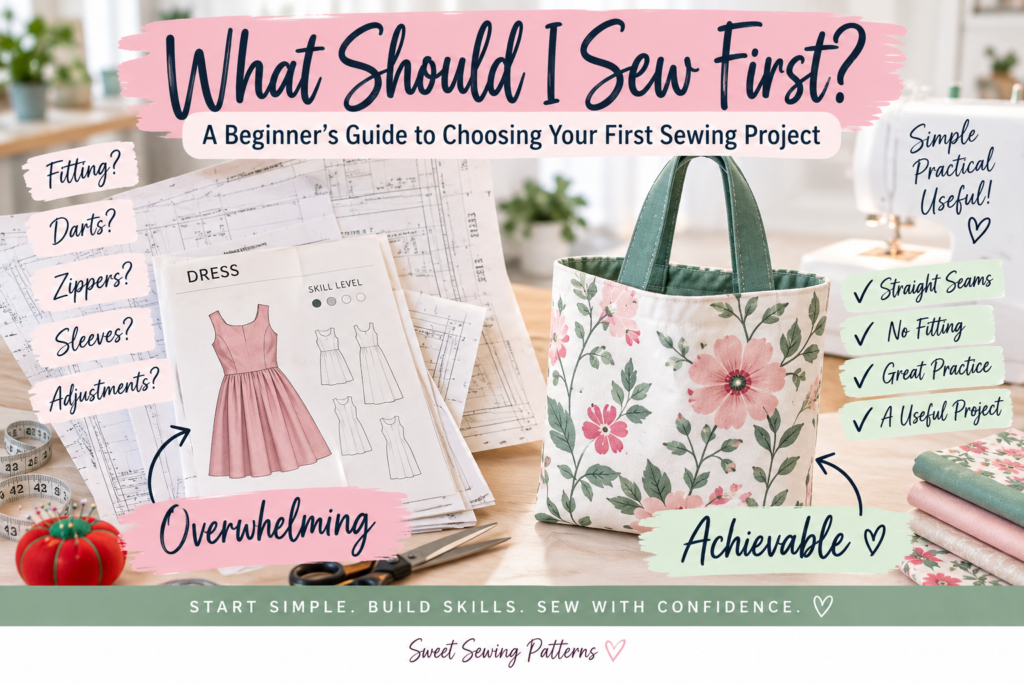
But if you’re wondering what to sew first as a beginner, it’s worth pausing before you jump straight into a fitted garment. A project that asks you to learn several unfamiliar techniques at once — fitting, darts, zippers, sleeves — can create a lot more difficulty than it needs to for someone who’s never sewn before. If you’re looking for an easy first sewing project with fewer technical hurdles, there’s a much lower-pressure place to start: a simple tote bag.
Here’s why.
GET THE FREE BEGINNER SEWING PATTERN DECODER
The First-Project Trap
Picture a common scenario: choosing a fitted dress or a button-down shirt as project number one.
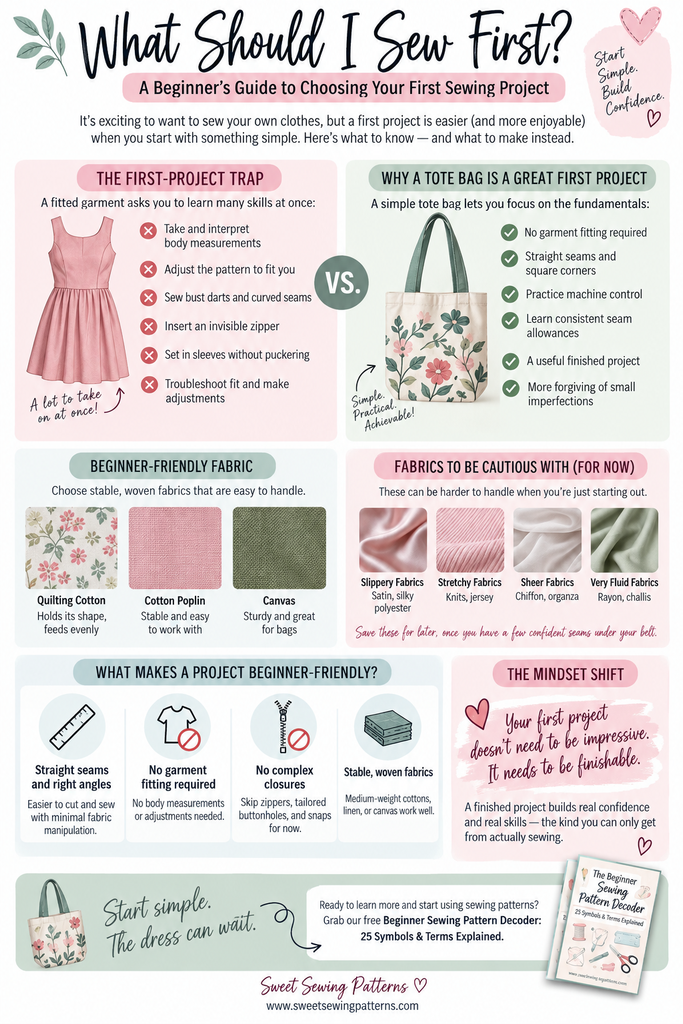
On the surface, it seems reasonable — it’s useful, it’s exciting, and patterns for it are everywhere. The thing is, a fitted garment doesn’t really let you learn one new skill at a time. It often asks you to take on several at once:
- Taking and interpreting body measurements
- Adjusting a pattern to fit your actual shape
- Sewing bust darts that curve fabric into a 3D shape
- Inserting an invisible zipper without it looking, well, visible
- Setting in sleeves so they hang without puckering
Any one of these is a reasonable skill to practice on its own. Several of them together, on day one, while you’re still getting comfortable with your machine, can add up to a lot more than necessary. And that’s often what leads to a first garment getting shoved in a drawer half-finished, followed by the very understandable thought: maybe sewing just isn’t for me.
It’s less about you, and more about how much a single project is asking you to take on at once.
Why a Simple Tote Bag Can Be a Good Place to Start
A tote bag looks almost too basic to be someone’s “first sewing project” — and that’s precisely the point. It strips away sources of friction that have nothing to do with actually learning to sew, and leaves you with the parts that matter.
No Garment Fitting Required
There’s no body to measure, no waistline to adjust, no bust cup to size up or down. A tote bag doesn’t care about your shape — it just needs straight seams and square corners. That means the very first time you sit down at your machine, you’re not troubleshooting fit. You’re just sewing.
Pure Machine Control Practice
Strip away darts and zippers and sleeves, and what’s actually left to learn? The fundamentals: guiding fabric smoothly under the needle, sewing a straight line, and keeping a consistent seam allowance from one end to the other. A tote bag is essentially several long, straight seams in a row — which makes it a low-pressure way to practice building real muscle memory with your machine.
A Useful Finished Project
When you’re finished, you have a practical item you can actually use — for groceries, library books, or even to hold the supplies for your next sewing project. And because a tote doesn’t need to fit a body, small cosmetic imperfections in your early stitching tend to be more forgiving than they might be on a fitted garment. A slightly wobbly seam on a bag is much less noticeable than the same seam on a bodice.
Choosing Beginner-Friendly Fabric
Your fabric choice can make this project feel effortless or oddly frustrating, so it’s worth a minute of thought before you cut.
Reach for a stable, woven cotton — quilting cotton or cotton poplin are both good choices. These fabrics hold their shape under the presser foot, feed evenly, and don’t shift or stretch while you’re sewing. That stability is helpful for a beginner, because it means the seam you’re sewing stays where you put it.
For this first project, it’s worth being a little cautious with fabrics that are slippery, stretchy, sheer, or very fluid — these can shift, slide, or bunch under the needle in ways that have less to do with your skill and more to do with how the fabric behaves. They’re not off-limits forever, just fabrics that tend to need a bit more handling than a first project calls for. Save them for later, once you’ve got a few confident seams under your belt.
The Core Mindset Shift
If there’s one idea to carry with you into every early sewing project, it’s this:
Your first project doesn’t need to be impressive. It needs to be finishable.
Finishing a simple project like a tote bag gives you the chance to practice a seam from start to end, without getting stuck partway through on a technique you haven’t learned yet. Every seam you complete builds real confidence and real muscle memory — the kind you can’t get from a tutorial video, only from fabric actually moving under your hands. Impressive can come later. Right now, the win is simply reaching the end.
Ready to Try a Sewing Pattern?
Once you’ve sewn a project or two and you’re ready to move toward an actual sewing pattern — even something simple, like an apron or an elastic-waist skirt — you’ll likely run into a new kind of confusion: pattern symbols and terminology. Notches, grainline, selvage, seam allowance, “place on fold” — it can feel like its own language at first.
If that sounds familiar, our free Beginner Sewing Pattern Decoder: 25 Symbols & Terms Explained walks through the most common symbols and terms you’ll come across on a pattern, in plain language, so you’re not left guessing what a pattern is asking you to do.