
If you’ve ever opened a pattern envelope, read three lines of the instructions, and quietly closed it again — you’re not bad at sewing. You just picked a project that was teaching you six new things at once.
Here’s how to stop guessing what to sew next and start choosing projects that actually build on what you already know.
Why Skill Progression Beats Random Pattern Picking
Most beginners don’t quit sewing because they lack talent. They quit because their second or third project asks them to learn five or six unfamiliar techniques in one sitting — inserting a zipper, easing a sleeve, understitching a facing, and installing a waistband, all before they’ve even mastered a straight seam.
That’s not a skill problem. That’s a sequencing problem.
Sewing is cumulative, the same way learning to cook is cumulative — you don’t start with a soufflé. Each technique you master (straight stitching, hemming, casings, curves, closures) becomes the foundation the next one is built on. When you skip rungs on that ladder, every mistake feels like proof you “just can’t sew,” when really you were just missing one or two prerequisite skills.
The fix isn’t more patience or more talent. It’s picking projects in the right order.
The 5-Level Skill Framework
Think of this as a map, not a rulebook. Each level introduces one or two new techniques and reinforces everything from the level before it. You don’t need to finish ten projects at each level — one or two confident makes is usually enough before you move up.
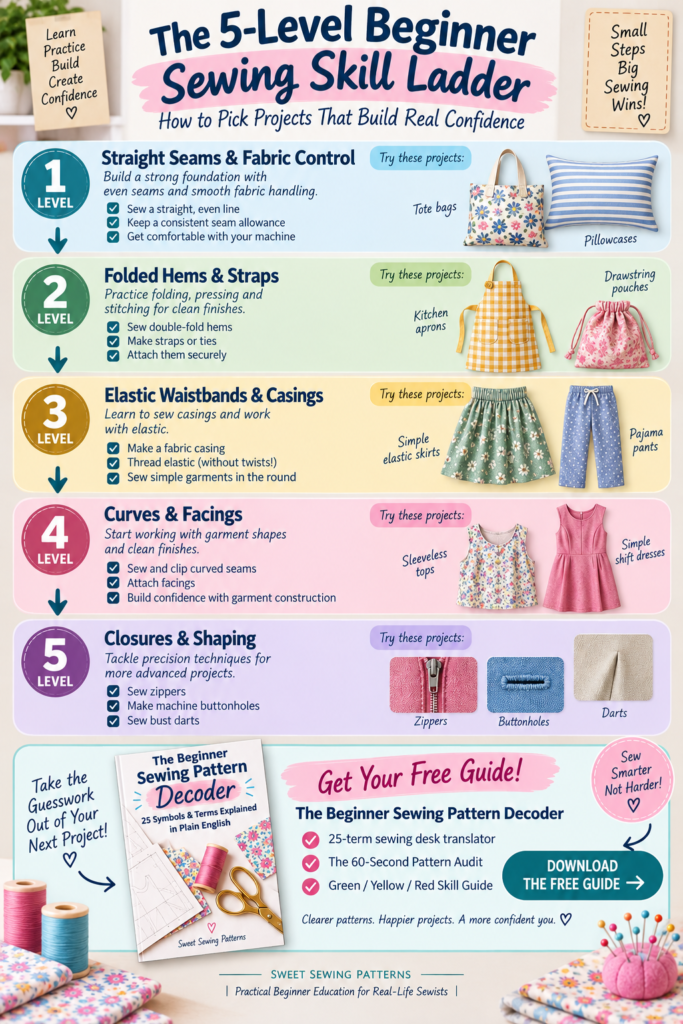
Level 1: Straight Seams & Fabric Control
Try: tote bags, pillowcases
This is where you build the skill nothing else works without — sewing a straight, even line while keeping the fabric feeding smoothly and the seam allowance consistent. Tote bags and pillowcases are almost all straight seams, which means mistakes are easy to spot and even easier to unpick. This is also where you get comfortable with your machine’s tension, speed, and pedal control before anything more complicated is riding on it.
Level 2: Folded Hems & Straps
Try: kitchen aprons, drawstring pouches
Now you’re adding folding and pressing accuracy — turning a raw edge under (often twice) and stitching it flat, plus constructing straps or ties and attaching them securely. Aprons and drawstring pouches let you practice this without curves or fitted shaping getting in the way.
Level 3: Elastic Waistbands & Casings
Try: simple elastic skirts, pajama pants
This level introduces casings — a folded tunnel of fabric — and the slightly fiddly skill of threading elastic through one without it twisting or disappearing inside the fabric. It’s also usually your first encounter with sewing in the round (a joined tube of fabric instead of flat panels), which is a small but important jump in spatial thinking.
Level 4: Curves & Facings
Try: sleeveless tops, simple shift dresses
Here’s where garments start to feel like garments. You’ll practice sewing and clipping curved seams (necklines, armholes) and attaching facings — the fabric pieces that finish those curved edges cleanly from the inside. This is the level where “it looked easy on the pattern” and “it actually behaves” start to diverge, which is exactly why it comes after you’ve built seam and pressing confidence, not before.
Level 5: Closures & Shaping
Try: basic zippers, machine buttonholes, bust darts
The final rung is precision work: zippers that need to line up, buttonholes that need to be sized and placed correctly, and darts that shape flat fabric around a curved body. These techniques ask for accuracy you’ve been building since Level 1 — which is exactly why they go last, not first.
How to Self-Audit Your Next Pattern
Before you buy fabric for any pattern, run this quick check:
- Read through the instructions once, start to finish, before touching fabric.
- List every technique the pattern requires (zipper, facing, casing, darts, etc.).
- Count how many of those techniques you’ve never done before.
If it’s zero or one new technique, you’re likely in good shape. If it’s two, expect a slower, more frustrating make — but a doable one. If it’s three or more, that pattern is probably two or three rungs above where you are right now, and it’s worth trading it for something closer to your current level.
This thirty-second habit is the single biggest thing that separates sewists who build momentum from sewists who end up with a drawer of unfinished projects.
Want the shortcut version of this whole system?
Grab The Beginner Sewing Pattern Decoder — a free download built to take the guesswork out of every pattern envelope you pick up next. Inside:
- A 25-term sewing desk translator, so pattern language stops feeling like a foreign language
- The 60-Second Pattern Audit, a faster version of the technique-count check above
- A Green / Yellow / Red Skill Guide, so you can tell at a glance whether a pattern matches your level, will stretch you a little, or is going to fight you