
How to Choose the Best Sewing Machines for Beginners
Choosing one of the best sewing machines for beginners can feel like a high-stakes decision, especially when you’re buying your very first machine. You are met with a wall of plastic and metal, each box boasting hundreds of decorative stitches and technical jargon that promises professional results. For many, the excitement of starting a new hobby is quickly dampened by the reality of the “first-week wall”—that moment when thread jams, broken needles, and runaway fabric make you question your talent.
🧵 Free Download: Looking for a quick reference sheet? Download our Free Sewing Machine Buying Guide
In reality, most beginners who give up early are not struggling with a lack of skill; they are struggling with mechanical frustration. The machine they chose may have a high stitch count, but it lacks the ergonomic and safety features necessary to support a learner. A machine that is difficult to set up or overly sensitive to minor errors acts as a technical hurdle rather than a tool for creativity.
The secret to a successful start isn’t finding the machine with the most features. It is finding the one that actively reduces setup frustration and provides a safety net for your first stitches. To make an informed choice, you must look past the marketing and understand how the architecture of a machine dictates your success.
Best Sewing Machines for Beginners: 4 Models Compared
Affiliate Disclosure: As an Amazon Associate I earn from qualifying purchases. Some links in this article are paid affiliate links, which means we may earn a commission at no additional cost to you.
Comparing the best sewing machines for beginners becomes easier when you focus on the features that matter most: speed control, ease of threading, stitch selection, and everyday usability. The following comparison highlights four popular models and explains which type of beginner each machine may suit.
| Sewing machine | Best suited for | Key advantage | Consideration |
|---|---|---|---|
| Brother CS7000X Check Brother CS7000X on Amazon | Beginners wanting guided controls | Adjustable speed slider and computerized stitch selection | More electronic features to learn |
| Singer 4423 Check Singer 4423 on Amazon | Beginners interested in a fast mechanical machine | High maximum sewing speed and straightforward controls | No dedicated maximum-speed slider |
| Janome HD3000 Check Janome HD3000 on Amazon | Beginners preferring a sturdy mechanical machine | Adjustable presser foot pressure and sturdy construction | Fewer automated conveniences |
| Bernette b05 Academy Check Bernette b05 Academy on Amazon | Beginners wanting mechanical controls with speed limiting | Switch for reducing maximum sewing speed | Less flexible speed limiting than a slider |
Which sewing machine should a beginner choose?
For someone who has never used a sewing machine before, the Brother CS7000X is a strong starting option because its adjustable speed control, LCD display, and preset stitch settings can reduce some of the guesswork involved in learning.
However, beginners who prefer mechanical controls may find the Janome HD3000 or Bernette b05 Academy more appealing. The Singer 4423 may suit someone who values higher sewing speed, although speed alone shouldn’t determine a first-machine purchase.
The best choice depends on your budget, the fabrics you plan to sew, and which controls feel comfortable to you.
1. Speed Control is Your Secret Superpower
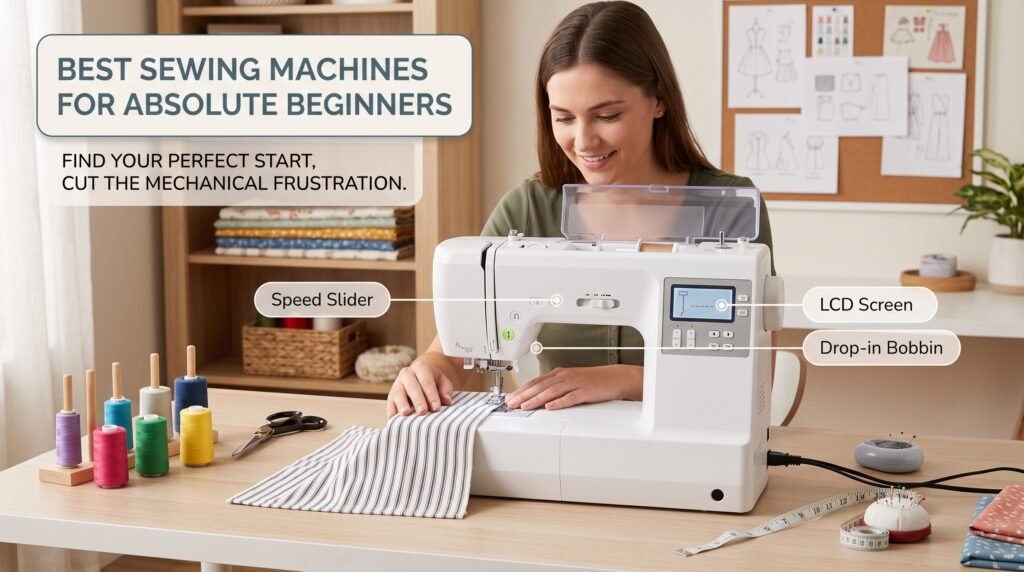
For a novice, having a dedicated speed control slider—as found on the Brother CS7000X—is far more valuable than having a massive library of 100+ stitches. While most introductory projects rely on a handful of utility stitches, every project requires precise motor control.
A speed slider acts as a mechanical safety net. Unlike basic machines where speed is controlled entirely by foot pressure, the hardware slider on the CS7000X actually “caps” the maximum speed of the foot controller. Even if a nervous beginner accidentally “floors” the pedal, the machine will only crawl at the set limit. This allows you to focus on guiding the fabric and navigating corners without the fear of runaway stitching.
“The speed limiter is especially valuable because it lets a nervous beginner cap maximum speed independently of pedal pressure.”
Before choosing a machine, check the manufacturer’s official product specifications to confirm which features are included with that particular model.
2. The “Heavy Duty” Label is Often Marketing, Not Magic
The term “Heavy Duty” is frequently used as a marketing hook, but it does not always mean a machine is easier or better for a beginner.
Consider the Singer 4423, which offers a maximum sewing speed of 1,100 stitches per minute (SPM). While this speed can be useful for experienced sewists, beginners may find a fast machine harder to control, especially when learning to sew straight seams or navigate corners.
In contrast, the Janome HD3000 features a heavy-duty aluminum frame and adjustable presser foot pressure. These features may appeal to beginners who want a sturdy machine that can accommodate different fabric types.
What Beginners Should Know About Motor Power
A sewing machine’s maximum stitch speed does not tell you how well it will handle thick fabric. Motor design, gearing, machine construction, needle selection, and fabric thickness all affect sewing performance.
Both machines have features worth considering, but neither motor amperage nor maximum sewing speed alone is enough to determine which will perform better on denim, canvas, or other heavy materials.
For beginners, consistent stitching, manageable speed, easy threading, and reliable fabric feeding are generally more useful buying considerations than raw speed.
3. Computerized Machines are the “Spell-Check” of Sewing
3. Computerized Machines Are the “Spell-Check” of Sewing
Computerized sewing machines can make learning easier by handling some of the settings that beginners might otherwise have to adjust manually.
For example, the Brother CS7000X and Brother XR9550 offer built-in stitch selections with preset stitch length and width settings. Beginners can start with these settings and adjust them when necessary for different fabrics or sewing techniques.
Another helpful feature is the LCD display. On compatible Brother models, the screen can show a recommended presser foot for the selected stitch. This helps beginners identify which foot to attach without constantly searching through the instruction manual.
Why These Features Matter for Beginners
- Less guesswork: Preset stitch settings provide a useful starting point.
- Easier setup: Presser-foot recommendations help you select the appropriate accessory.
- More confidence: Clear displays make it easier to understand the machine’s settings.
- Room to grow: Adjustable stitch settings let you experiment as your skills improve.
Computerized machines are not completely mistake-proof. You still need to thread the machine correctly, select a suitable needle, and follow the manufacturer’s instructions.
For absolute beginners, the biggest advantage is not having hundreds of decorative stitches. It’s having controls and guidance that make everyday sewing tasks easier to learn.
“This digital error-prevention system drastically reduces mechanical misconfigurations, needle breakage, and foot collisions.”
4. Bobbins and Feed Dogs: What Beginners Need to Know
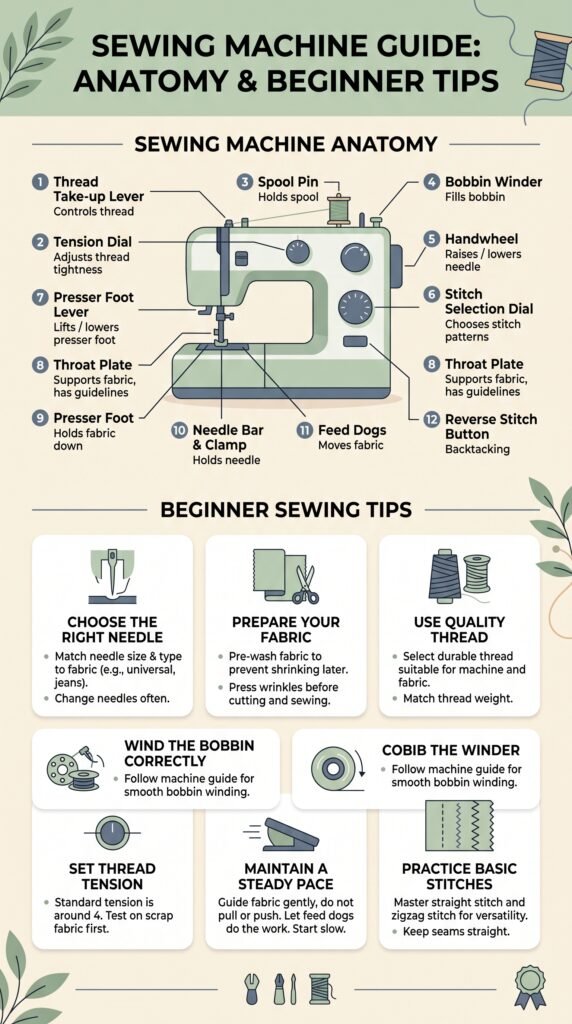
Two sewing machine features that can affect your experience as a beginner are the bobbin system and the feed dogs. Understanding these features can help you choose a machine that’s easier to operate.
Top-Loading vs. Front-Loading Bobbins
A bobbin holds the lower thread that works with the upper thread to form stitches.
Many modern beginner sewing machines, including the Brother CS7000X, use a top-loading bobbin system. The bobbin drops into a compartment beneath a removable cover near the needle plate.
Other machines use a front-loading bobbin system, where the bobbin sits inside a removable bobbin case.
Both designs can produce excellent stitches when threaded and maintained correctly.
For beginners, a top-loading bobbin may offer a few conveniences:
- Easy access: You can insert or remove the bobbin without opening a front compartment.
- Thread visibility: A transparent cover may allow you to see how much thread remains.
- Simplified setup: Some machines include quick-set bobbin systems that reduce the number of threading steps.
However, a top-loading bobbin does not automatically prevent thread jams. Correct threading, proper bobbin placement, and regular cleaning are still important.
What Are Feed Dogs?
Feed dogs are the small metal teeth beneath the presser foot that move fabric through the sewing machine as you stitch.
Some machines use different feed dog arrangements to help support and move fabric. However, the number of feed dog teeth or segments alone does not determine how well a machine will sew.
Fabric feeding also depends on presser foot pressure, fabric type, machine design, and proper sewing technique.
Beginner Buying Tip: Rather than choosing a machine based solely on its bobbin design or number of feed dogs, look for one with clear threading instructions, accessible controls, and consistent fabric feeding.
5. The “Birdnesting” Myth (It’s Not Always the Bobbin’s Fault)
“Birdnesting” happens when loose thread gathers into a tangled mess underneath your fabric. It’s one of the most frustrating problems beginners encounter when learning to sew.
Although the tangled thread often appears near the bobbin, the problem may actually begin with the upper threading.
Why Upper Threading Matters
On many sewing machines, raising the presser foot opens the upper thread tension discs. This allows the thread to settle correctly between them during threading.
If you thread the machine with the presser foot lowered, the thread may not seat properly in the tension system. The result can be loose stitches, uneven tension, or tangled thread underneath your fabric.
What to Check When Your Thread Keeps Tangling
- Raise the presser foot: Rethread the upper thread path with the presser foot raised, following your machine’s manual.
- Check the bobbin: Make sure the bobbin is correctly inserted and the thread follows the proper path.
- Inspect the needle: Replace a bent, damaged, or incorrectly installed needle.
- Check the thread: Use suitable thread and confirm that both the upper and bobbin threads are threaded correctly.
- Clean the bobbin area: Remove accumulated lint using the cleaning method recommended by the manufacturer.
- Test on scrap fabric: Sew a short line of stitches to see whether the problem has been resolved.
Beginner Tip: When thread tangles underneath your fabric, start by checking the upper threading rather than immediately adjusting the bobbin tension.
Correct threading solves many common problems, but persistent tangling may require additional troubleshooting or professional servicing.
6. Beginner Sewing Machine Maintenance: What You Need to Know
Taking care of your sewing machine doesn’t have to be complicated. A few simple maintenance habits can help prevent thread jams, skipped stitches, and unnecessary frustration.
However, different sewing machines have different maintenance requirements. Always follow the instructions provided by your machine’s manufacturer.
1. Check the Manual Before Oiling
Some sewing machines require occasional lubrication, while others are designed so that routine oiling is not necessary for the owner.
For example, many computerized machines have specific maintenance instructions and may require professional servicing for internal lubrication.
Never add oil unless your sewing machine’s manual specifically instructs you to do so. Using the wrong oil or applying it in the wrong location can cause problems.
2. Remove Lint Carefully
Fabric and thread naturally produce lint as you sew. Over time, lint can accumulate around the bobbin area and feed dogs.
Use a small cleaning brush or another manufacturer-approved method to remove accessible lint.
Avoid blowing compressed air into the machine unless the manufacturer recommends it, because it may push lint farther into the mechanism.
3. Replace Needles Regularly
Sewing machine needles become dull or damaged with use.
A common guideline is to replace your needle after approximately 6–8 hours of active sewing, but the appropriate interval depends on the fabric, needle type, and sewing conditions.
Replace the needle sooner if you notice:
- Skipped stitches
- Unusual popping sounds as the needle enters the fabric
- Visible needle damage or bending
- Snagged or damaged fabric
4. Keep Your Machine Covered
When you’re not sewing, protect your machine from dust with a suitable cover. Store it in a clean, dry location.
Beginner Maintenance Tip: Before attempting any maintenance, turn off the machine and unplug it when instructed by the manufacturer. Consult your manual before removing parts or applying lubricants.
Simple cleaning, correct needle selection, and following your manufacturer’s maintenance schedule can help keep your machine working reliably.
Choosing the right sewing machine is only part of getting started. Our Beginner’s Guide to Sewing Essentials explains which basic tools and supplies you actually need and which purchases can wait.
7. Why Speed Control Matters: The Bernette b05 Academy
For beginners, controlling sewing speed can make learning much less intimidating. A machine that lets you slow down gives you more time to guide fabric, maintain straight seams, and practice turning corners.
The Bernette b05 Academy is a mechanical sewing machine with a useful feature: a speed-limiting switch.
The machine has a maximum sewing speed of approximately 1,100 stitches per minute. When its speed limiter is activated, the maximum speed is reduced to approximately 650 stitches per minute.
Why This Feature Helps Beginners
- Better control: Slower stitching gives you more time to guide fabric accurately.
- Less intimidation: You can practice without immediately reaching the machine’s highest speed.
- Useful for detailed work: Reduced speed can help when sewing curves, corners, and other areas requiring precision.
- Room to improve: As your confidence grows, you can use higher speeds when appropriate.
How Does It Compare With the Brother CS7000X?
The Brother CS7000X offers an adjustable sewing speed control slider, while the Bernette b05 Academy uses a switch to limit its maximum speed.
Both approaches can help beginners develop confidence and control.
However, speed control alone does not determine how well a machine handles thick fabric. Needle selection, fabric type, machine construction, and other factors also influence sewing performance.
Beginner Buying Tip: If you’re nervous about controlling a sewing machine, look for a model with adjustable speed control or a speed limiter. These features can make your first sewing projects more manageable.
Conclusion: Your First Stitch is a Diagnostic
Choosing your first sewing machine doesn’t have to be overwhelming. The best sewing machines for beginners aren’t necessarily the ones with the most stitches, the highest speeds, or the biggest collection of accessories.
What matters most is finding a machine that makes learning comfortable and manageable.
If you’re looking for computerized assistance and adjustable speed control, the Brother CS7000X is worth considering.
If you prefer mechanical controls, the Janome HD3000 and Bernette b05 Academy offer different features that may appeal to you.
The Singer 4423 is another option, particularly if you want a mechanical machine with a high maximum sewing speed.
Before buying, compare the features, check the manufacturer’s current specifications, and consider the types of projects you want to sew.
One Final Beginner Tip: Save Your First Successful Stitches
Once you’ve set up your machine and sewn a successful line of stitches, save that scrap of fabric.
Write down:
- Needle size: For example, 90/14 Universal.
- Thread type: For example, all-purpose polyester.
- Tension setting: For example, 4.0, if your machine has an adjustable tension dial.
Keep this sample near your sewing machine.
If you experience stitching problems later, it can serve as a useful reference when troubleshooting. Remember that different fabrics and techniques may require different settings.
Your first sewing machine should help you build confidence, not make you feel overwhelmed. Start with simple projects, practice regularly, and focus on learning one skill at a time.
Keep This Guide by Your Sewing Table
Get our full machine comparison matrix, model profiles, and birdnesting diagnostic chart in a clean, printable format.
⬇ Download Free Sewing Machine GuideAre you choosing a machine that empowers your creativity, or one that adds a technical hurdle to every project?